Pickleball Singles Rules | Best Pickleballs
Pickleball singles is a challenging variation of the popular doubles game, played on the same 20×44 foot court but with only one player per side. The rules largely mirror doubles play, with key differences in serving and scoring. Players serve diagonally from alternating courts based on their score, with only one serve attempt allowed. Scoring is simplified, using just two numbers (server’s score, then receiver’s score), typically to 11 points. The two-bounce rule and non-volley zone restrictions apply.
Singles demand greater court coverage and endurance, leading to more backcourt play and longer rallies. Strategies include powerful deep serves, quick net approaches, and exploiting opponents’ weaknesses. While physically demanding and potentially less social than doubles, singles offer a unique challenge that hones individual skills. Variations like “skinny singles” provide alternatives for finding full-court play too strenuous. Understanding these rules and strategies is crucial for excelling in pickleball singles.
#1 Pickball Paddles Set of 2 | #1 Pickball Paddles Set of 4 | #1 Pickball Single Paddle |
 3000+ Reviews Free Shipping at Amazon.com |  200+ Reviews Free Shipping at Amazon.com |  800+ Reviews Free Shipping at Amazon.com |
Pickleball Singles Rules: Mastering the One-on-One Game
Pickleball, the fast-growing sport that combines elements of tennis, badminton, and table tennis, has traditionally been played as a doubles game. However, singles pickleball has been gaining popularity, especially among younger players and those with tennis backgrounds. This article will delve into the rules of pickleball singles, highlighting the unique aspects of this challenging variation.
Court Dimensions and Setup
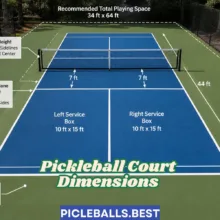
In singles pickleball, players use the same court as in doubles, measuring 20 feet wide by 44 feet long. This means each player is responsible for covering 440 square feet of court space. The non-volley zone, affectionately known as the “kitchen,” extends 7 feet from the net on both sides. Understanding these dimensions is crucial for proper positioning and strategy in singles play.
Equipment
The equipment for singles pickleball remains the same as for doubles. Players need a good quality pickleball paddle that is approved for tournament play if competing officially. Pickleballs are plastic waffle-style balls designed specifically for the sport. Given the increased movement in singles play, proper athletic clothing and shoes with good traction are essential.
Serving Rules
Serving in singles pickleball follows specific rules that players must master:
- The server must stand behind the baseline and serve diagonally across the court.
- The serve must be made with an underhand stroke, with the paddle contacting the ball below waist level.
- The first serve of the game is always made from the right-hand court.
- Subsequent serves alternate between right and left courts based on the server’s score.
- A “drop serve” option is allowed, where the ball can be dropped and hit without the upward arc requirement.
One key difference in singles is that players only have one serve attempt, unlike doubles where each team member gets a chance to serve before a side-out occurs.
Scoring System
The scoring system in singles pickleball is more straightforward than in doubles:
- Only the serving player can score points.
- Games are typically played to 11 points, and a player must win by 2 points.
- The score is called using only two numbers – the server’s score followed by the receiver’s score.
- The player’s score determines which side they serve from: even scores (0, 2, 4, etc.) serve from the right, odd scores (1, 3, 5, etc.) from the left.
Gameplay Rules
Most gameplay rules in singles pickleball are identical to doubles:
- The two-bounce rule requires the serve and return to bounce before being played.
- Players must avoid touching the non-volley zone when volleying.
- Line calls are made in favor of the opponent if there’s doubt.
- Faults result in either a point for the receiving player or a loss of serve for the serving player.
Player Positioning and Movement
In singles, player positioning is crucial due to the larger area each player must cover:
- The server starts behind the baseline, while the receiver positions themselves to return serve.
- After serving, players should move quickly to the non-volley zone line to gain a strategic advantage.
- Throughout the rally, players must cover the entire court, requiring quick movements and good anticipation.
Singles vs. Doubles: Key Differences
Singles pickleball differs significantly from doubles in several ways:
- Court coverage: Players must cover the entire court alone, leading to more backcourt play and longer rallies.
- Scoring and serving: The patterns are simplified without the need for a third number to indicate the server.
- Physical demands: Singles is generally more physically demanding due to increased court coverage.
- Social aspect: Singles can feel less social than doubles, which may be a downside for some players.
Singles Pickleball Strategy
Successful singles strategy involves:
- Deep, powerful serves to push opponents back.
- Approaching the net quickly to cut off angles.
- Aiming for the opponent’s weaker side, often the backhand.
- Utilizing angles and passing shots to find open court space.
- Managing energy and endurance throughout the game.
Common Rule Misconceptions
Players new to singles often misunderstand:
- Serving rules, particularly regarding positioning based on score.
- Scoring, especially those accustomed to doubles play.
- Non-volley zone violations, which can be more frequent in singles due to increased court coverage.
Officiating and Etiquette
Most recreational singles games are self-officiated, requiring players to make their own line calls honestly. Referees may be present during tournament play. Good sportsmanship is essential, including respecting opponents’ calls and maintaining a positive attitude.
Variations of Singles Play
“Skinny singles” is a popular variation where only half the court is used, either down the line or cross-court. This reduces the physical demand while maintaining singles strategy. “Slender singles” further narrows the court by 20%, making it even more accessible for players who find full-court singles challenging.
Tournament Considerations
Singles tournaments may have different scoring formats, sometimes playing to 15 or 21 points. Age divisions and skill levels are often used to group players fairly. Warm-up protocols and equipment regulations are typically more strictly enforced in tournament settings than in recreational play.
Adaptations for Different Playing Environments
Singles pickleball can be played both indoors and outdoors, with slight adjustments needed for different surfaces and conditions. Indoor play often involves faster-paced games due to lack of wind, while outdoor play may require adapting to sun position and wind effects on the ball.
Tips for Improving Your Singles Game
Improving in singles pickleball requires:
- Physical fitness and endurance training.
- Skill development, especially in serves, returns, and groundstrokes.
- Strategic thinking and mental preparation.
- Consistent practice and match play experience.
Downsides of Singles Pickleball
While singles pickleball offers many benefits, there are some potential downsides:
- Increased physical demand, which may be challenging for some players.
- Less social interaction compared to doubles play.
- Potentially more intense and competitive atmosphere.
- Fewer opportunities for recreational play, as many facilities prioritize doubles due to court availability.
Conclusion: Embracing the Challenge of Pickleball Singles
Singles pickleball offers a unique and challenging way to enjoy the sport. It provides an excellent workout, hones individual skills, and tests both physical and mental abilities. While it may be more demanding than doubles, many players find singles to be a rewarding and exciting variation of the game that enhances their overall pickleball experience.
As the sport continues to grow, it’s likely that singles pickleball will gain even more popularity. Understanding the rules, strategies, and unique aspects of singles play can help players decide if this variation is right for them and how to excel at it. Whether you’re a seasoned doubles player looking for a new challenge or a newcomer to the sport, singles pickleball offers an exciting opportunity to test your skills and push your limits on the court.
#1 Pickball Balls | #1 Pickball Bag | #1 Pickball Portable Net |
 19500+ Reviews Free Shipping at Amazon.com |  2600+ Reviews Free Shipping at Amazon.com |  1800+ Reviews Free Shipping at Amazon.com |
Summary and FAQs
How does scoring in singles pickleball differ from doubles?
I’ll explain how singles pickleball scoring differs from doubles in a clear, concise way:
Singles Pickleball Scoring:
- Uses only 2 numbers when calling the score (server’s score, receiver’s score)
- Only one serve per side before a side-out
- Games typically played to 11 points (win by 2)
- Server’s position determined by their score:
- Even scores (0,2,4…) → serve from right
- Odd scores (1,3,5…) → serve from left
Doubles Pickleball Scoring (for contrast):
- Uses 3 numbers when calling the score (server team’s score, receiver team’s score, server number 1 or 2)
- Both team members serve before a side-out
- Games typically played to 11 points (win by 2)
- Starting server designated as #2, partner as #1
- Teams switch positions based on score rather than individual players
The key simplification in singles is the elimination of the third number needed to track which team member is serving, since there’s only one player per side.
What is the “two-bounce rule” in pickleball singles, and how does it apply?
Here’s an explanation of the two-bounce rule:
The two-bounce rule in pickleball singles states that:
- The serve must bounce once on the receiver’s side
- The return of serve must also bounce before being played by the serving player
This is identical to doubles play – the rule doesn’t change between formats.
The purpose of this rule is to:
- Prevent immediate volleying/smashing of serves
- Create longer rallies
- Reduce the advantage of serving
- Allow more time for players to move into position
After these first two mandatory bounces are completed, players can then:
- Volley the ball (hit it before it bounces)
- Let it bounce
- Play any type of shot they choose
This rule is fundamental to pickleball’s gameplay and helps keep rallies more strategic rather than just becoming quick serve-and-volley points. It’s particularly important in singles where players have more court to cover and need that extra time provided by the bounces to get into position.
Are the serving rules different for singles pickleball compared to doubles?
There are some key differences in serving rules between singles and doubles pickleball:
Key Differences:
- Singles only gets ONE serve attempt per side (vs. doubles where both team members serve)
- No second server or switching of positions with a partner
- Server’s position is based solely on their own score (even/odd)
Similarities (rules that stay the same):
Basic serving technique requirements:
- Must be underhand stroke
- Contact ball below waist level
- Serve diagonally across court
- Server must be behind baseline
- Drop serve option is allowed
Starting position rules:
- First serve of game always from right-hand court
- Even scores (0,2,4…) serve from right
- Odd scores (1,3,5…) serve from left
The main simplification in singles serving is the elimination of the partner rotation and second server aspects that exist in doubles. This makes the serving sequence more straightforward, though the fundamental serving technique requirements remain identical.
What is “skinny singles” in pickleball, and how does it differ from regular singles?
“skinny singles” is a popular variation of regular singles pickleball. Here’s how they differ:
Skinny Singles:
- Uses only half the court width
- Can be played in two ways:
- Down the line (lengthwise)
- Cross-court
- Main purpose: Reduces physical demand
- Maintains singles strategy elements
- More accessible format
Regular Singles:
- Uses full court width (20 feet)
- Covers entire 440 square feet of court space
- More physically demanding
- Requires more court coverage
- Uses full diagonal serving pattern
There’s also a further variation mentioned called “Slender Singles”:
- Narrows the court by 20% (even smaller than skinny singles)
- Makes the game even more accessible
- Further reduces physical demands
The key benefit of these variations is that they make singles play more manageable for players who:
- Find full-court singles too physically challenging
- Want to practice singles strategy with less movement
- Are new to singles play
- Want to focus on specific skills in a reduced space
These modified formats serve as good training grounds or alternatives while maintaining the core aspects of singles strategy.
How does court positioning differ in singles pickleball compared to double?
Here’s how court positioning differs between singles and doubles pickleball:
Singles Positioning:
- One player must cover entire 440 square feet alone
- After serving, quick movement to non-volley zone line is crucial
- More backcourt play is common
- Requires:
- Greater court coverage
- Quicker movements
- Better anticipation
- More endurance
- More strategic positioning to cover angles
Doubles Positioning (for contrast):
- Two players share court coverage
- Traditional “stacked” or “side-by-side” formations possible
- Each player covers roughly half the court width
- Players can specialize in front or back court positions
- More net play is common due to better court coverage
Key Positioning Considerations for Singles:
- Server starts behind baseline
- Receiver positions for optimal return
- Players must balance:
- Moving up to non-volley line for advantage
- Staying back enough to cover lobs
- Being ready to cover wide angles
- Maintaining center court position when possible
The main challenge in singles is the increased court coverage responsibility, which requires more dynamic and adaptable positioning strategies compared to doubles.