Pickleball Doubles Rules | Best Pickleballs
Pickleball doubles is the most popular format of this rapidly growing sport, combining elements of tennis, badminton, and table tennis. Played on a 20×44 foot court, it features unique rules like the non-volley zone (“kitchen”) and the two-bounce rule. The scoring system is side-out, with only the serving team able to score points. Games are typically played to 11 points, win by 2. Serving rules and rotation are complex, requiring understanding for proper gameplay.
Strategies involve effective partner communication, positioning, and shot selection. Common rule violations include foot faults and kitchen violations. Equipment rules ensure fair play, while tournament regulations add further complexity. Pickleball emphasizes good sportsmanship and etiquette. Advanced concepts like stacking can enhance team performance. Despite potential challenges such as a learning curve and court availability issues, pickleball doubles offer a unique blend of strategy, skill, and social interaction suitable for players of all ages and skill levels.
#1 Pickball Paddles Set of 2 | #1 Pickball Paddles Set of 4 | #1 Pickball Single Paddle |
 3000+ Reviews Free Shipping at Amazon.com |  200+ Reviews Free Shipping at Amazon.com |  800+ Reviews Free Shipping at Amazon.com |

Pickleball Doubles Rules: A Comprehensive Guide
Pickleball, the fastest-growing sport in America, has taken the nation by storm with its unique blend of tennis, badminton, and table tennis elements. While both singles and doubles formats exist, doubles pickleball reigns supreme in popularity. This comprehensive guide will delve into the intricacies of pickleball doubles rules, helping both novices and seasoned players navigate the game with confidence.
Court Dimensions and Layout
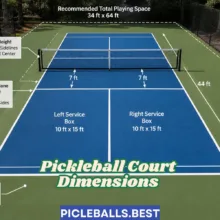
A pickleball court, measuring 20 feet wide by 44 feet long, is identical for both singles and doubles play. The non-volley zone, affectionately known as “the kitchen,” extends 7 feet from the net on both sides. The net stands 36 inches high at the sidelines and dips slightly to 34 inches at the center. Understanding this layout is crucial for proper positioning and strategy in doubles play.
Scoring System
Pickleball doubles employ a side-out scoring system, where only the serving team can score points. Games are typically played to 11 points, and teams must win by 2 points. One unique aspect of pickleball is its three-number scoring announcement before each serve:
- Serving team’s score
- Receiving the team’s score
- Server number (1 or 2)
For example, a score announcement of “4-3-2” means the serving team has 4 points, the receiving team has 3 points, and it’s the second server’s turn.
Serving Rules and Rotation
Serving in pickleball doubles follows specific rules:
- The serve must be made diagonally and underhand.
- Contact with the ball must occur below the server’s waist.
- The server’s feet must remain behind the baseline until contact is made.
- The serve must clear the non-volley zone.
The two-bounce rule requires both the serve and the return to bounce before being played. This rule helps neutralize the serving advantage and encourages longer rallies.
Serve rotation in doubles is more complex than in singles:
- At the start of each game, only the player on the right side serves (starting score: 0-0-2).
- When the serving team scores, partners switch court positions.
- Both team members serve before a side-out occurs, except for the first serve of each team’s service turn.
- After a side-out, the player on the right side of the receiving team becomes the first server.
Understanding serve rotation is key to proper gameplay and can be a source of confusion for newcomers.
Gameplay Rules
Doubles pickleball revolves around several key rules:
- Non-volley zone (kitchen) restrictions: Players cannot volley the ball while standing in or touching the kitchen, including the lines.
- Volleys and groundstrokes: After the initial two bounces, players can hit the ball in the air or after one bounce.
- Double bounce rule: The serving and receiving teams must each let the ball bounce once before hitting it.
- Faults: These occur when rules are violated, resulting in a point for the opposing team or a loss of serve.
Player Positioning and Movement
Proper positioning in doubles pickleball is crucial for success:
- The serving team starts with both players behind the baseline.
- The receiving team has one player at the non-volley zone line and one at the baseline.
- After the serve, players can move freely around the court.
- The goal is often to advance to the non-volley zone line for better offensive opportunities.
Partners must coordinate their movements and cover their respective areas of the court effectively.
Doubles Strategies
Successful doubles play hinges on several key strategies:
- Effective partner communication
- Both players advanced to the non-volley zone line
- Using dinks and drop shots to control the pace
- Employing offensive tactics like poaching
- Stacking (advanced teams) to leverage individual player strengths
Common Rule Violations and Penalties
Understanding and avoiding common rule violations is crucial:
- Foot faults during serves
- Kitchen violations
- Service faults
- Hindrance (distracting opponents)
Penalties for these violations typically result in loss of the rally or service.
Equipment Rules
Pickleball equipment rules ensure fair play:
- Paddles must meet specific size and composition requirements.
- The plastic ball must have the correct size, weight, and hole pattern.
- Appropriate athletic attire is expected, especially in tournaments.
Tournament Rules and Regulations
Tournament play introduces additional considerations:
- Time-out regulations
- Referee responsibilities in officiated matches
- Line call challenge procedures
Some professional leagues may have variations on standard rules, such as different scoring systems or service rules.
Etiquette and Sportsmanship
Pickleball is renowned for its emphasis on good sportsmanship and etiquette:
- Respectful communication with partners and opponents
- Fair line calling
- Proper dispute resolution
The social aspect of the game contributes significantly to its growing popularity.
Advanced Concepts
As players progress, they can explore advanced concepts:
- Stacking: Partners maintain the same side of the court regardless of the score.
- Third shot drop: A crucial strategy to neutralize the receiving team’s advantage.
- Adapting strategies to complement each partner’s strengths.
Downsides and Challenges
While pickleball doubles is an engaging and accessible sport, it’s important to note some potential downsides:
- Learning curve: The unique rules and scoring system can be confusing for beginners.
- Physical demands: Despite having a lower impact than tennis, pickleball can still be physically demanding, especially for older players.
- Court availability: The sport’s growing popularity has led to crowded courts and long wait times in some areas.
- Noise concerns: The distinctive “pop” of the ball hitting the paddle has led to noise complaints in some communities.
- Potential for disputes: Line calls and rule interpretations can sometimes lead to disagreements, especially in casual play without officials.
Conclusion
Pickleball doubles offer a unique blend of strategy, skill, and social interaction. By understanding the rules, mastering basic techniques, and developing effective teamwork, players can fully enjoy this engaging sport. The complex serve rotation and scoring system add depth to the game, while the emphasis on sportsmanship creates a welcoming environment for players of all levels.
As pickleball continues to grow in popularity, it’s likely that rules and regulations will continue to evolve. The USA Pickleball Association (USA Pickleball) regularly updates its official rulebook to address new situations and improve gameplay. Players are encouraged to stay informed about any rule changes and to always prioritize fair play and good sportsmanship.
Despite the potential challenges, the benefits of pickleball doubles far outweigh the downsides for most players. The sport offers excellent exercise, social interaction, and mental stimulation. It’s accessible to a wide range of ages and skill levels, making it an ideal activity for families, friends, and communities.
As with any sport, regular practice and a willingness to learn will help improve performance and enhance the overall experience of playing pickleball doubles. Whether you’re a seasoned player or just picking up a paddle for the first time, the world of pickleball doubles offers endless opportunities for fun, fitness, and friendly competition. this rapidly growing sport.
#1 Pickball Balls | #1 Pickball Bag | #1 Pickball Portable Net |
 19500+ Reviews Free Shipping at Amazon.com |  2600+ Reviews Free Shipping at Amazon.com |  1800+ Reviews Free Shipping at Amazon.com |
Summary and FAQs
What is the “two-bounce rule” in pickleball doubles?
The two-bounce rule in pickleball doubles is a specific requirement that occurs at the start of each rally. Let me explain it clearly:
The Two-Bounce Rule:
- First bounce: When the serving team serves, the ball must bounce once on the receiving team’s side
- Second bounce: When the receiving team returns the serve, the ball must bounce once on the serving team’s side
After these initial two bounces are complete, players can then hit the ball either:
- In the air (volley)
- After it bounces
Purpose of the rule:
- Helps neutralize any serving advantage
- Encourages longer rallies
- Makes the game more engaging for players
This is different from other racquet sports and is one of pickleball’s distinctive features. It’s sometimes also called the “double bounce rule” and applies to both casual and tournament play.
How does the scoring system work in pickleball doubles?
The pickleball doubles scoring system has several unique characteristics. Let me break it down clearly:
Key Elements:
- Side-out scoring: Only the serving team can score points
- Winning score: Games are played to 11 points
- Margin of victory: Teams must win by 2 points
Scoring Announcement:
Before each serve, players must announce three numbers in this order:
- Serving team’s score
- Receiving team’s score
- Server number (either 1 or 2)
Example:
- If a player announces “4-3-2” this means:
- Serving team has 4 points
- Receiving team has 3 points
- It’s the second server’s turn
Server Rotation Rules:
- Game starts with only the right-side player serving (0-0-2)
- When serving team scores, partners switch court positions
- Both team members get to serve before a side-out (except first serve of each team’s turn)
- After a side-out, the right-side player of the receiving team becomes first server
This scoring system is more complex than many other racquet sports but helps maintain order and fairness in the game.
Can you explain the serving rotation in pickleball doubles?
Yes, the serving rotation in pickleball doubles has specific rules and patterns. Let me break it down systematically:
Starting the Game:
- Initial position: Both players of serving team start behind baseline
- First serve of the game:
- Only right-side player serves
- Starting score is 0-0-2
- This is unique to the first serve of the game
Regular Service Rotation:
When serving team scores:
- Partners switch court positions
- Same player continues serving
Both partners get to serve during their team’s service turn:
- Exception: First serve of each team’s turn
- Server 1 serves until they lose a point
- Then Server 2 serves until losing a point
Side-out Rules:
When serving team loses a rally:
- Service goes to the other team (side-out)
- The right-side player of receiving team becomes first server
Court Positioning:
Serving team:
- Both players behind baseline during serve
Receiving team:
- One player at baseline (to receive)
- One player at non-volley zone line
This systematic rotation ensures fair play and equal opportunities for all players to serve, though it can be confusing for newcomers to master.
What are the rules regarding the non-volley zone (kitchen) in pickleball doubles?
Let me explain the rules regarding the non-volley zone (commonly called “the kitchen”) in pickleball doubles:
Physical Dimensions:
- Extends 7 feet from the net on both sides
- Area includes the lines marking the zone
Key Restrictions:
Volley Rules:
- Players cannot volley (hit the ball in the air) while:
- Standing in the kitchen
- Touching any part of the kitchen (including lines)
- Having momentum that causes them to touch the kitchen after the volley
Allowed Actions in Kitchen:
- Players can enter the kitchen at any time
- Players can hit the ball after it bounces
- Players can stay in the kitchen as long as they want
Strategic Aspects:
Court Positioning:
- Typically one receiving team player stands at kitchen line
- Players often try to advance to kitchen line for better offensive opportunities
- Must maintain awareness of kitchen boundaries during play
Common Violations:
- Stepping into kitchen during volley
- Momentum carrying player into kitchen after volley
- These result in loss of rally or service
Understanding and following these kitchen rules is crucial for proper gameplay, as violations can result in lost points or service opportunities.
What is “stacking” in pickleball doubles, and is it allowed?
Let me explain stacking in pickleball doubles:
Stacking is an advanced strategy that is completely legal in pickleball doubles. Here’s what you need to know:
Definition:
- It’s a positioning strategy where partners maintain the same side of the court regardless of the score
- This differs from standard positioning where players switch sides based on the score
Purpose:
- Allows teams to leverage each player’s individual strengths
- For example, keeping a stronger forehand player on one side consistently
- Can help teams maintain tactical advantages throughout the game
When it’s used:
- Typically employed by advanced players
- Most common in competitive or tournament play
- Less frequently seen in recreational games
While stacking can be an effective strategy, it requires:
- Strong communication between partners
- Good court awareness
- Understanding of proper rotation rules
- Practice to execute properly