Pickleball Faults To Avoid | Best Pickleballs
Pickleball faults are rule violations that stop play and can significantly impact the game’s outcome. Common faults include service errors, two-bounce rule violations, non-volley zone (kitchen) infractions, boundary faults, net faults, and double bounce faults. To avoid these, players should master proper serving techniques, adhere to the unique two-bounce rule, maintain awareness of the kitchen line, improve shot accuracy, and develop quick reflexes.
Strategies to minimize faults include studying the rules, practicing proper techniques, enhancing footwork, developing court awareness, focusing on control rather than power, and observing experienced players. While avoiding faults is crucial, potential downsides include overcautiousness, mental pressure, slowed reaction time, and reduced aggression in play. Despite these challenges, understanding and avoiding faults is essential for improving one’s pickleball skills. With practice, players can naturally integrate fault avoidance into their gameplay, leading to a more enjoyable and competitive experience on the court.
#1 Pickball Paddles Set of 2 | #1 Pickball Paddles Set of 4 | #1 Pickball Single Paddle |
 3000+ Reviews Free Shipping at Amazon.com |  200+ Reviews Free Shipping at Amazon.com |  800+ Reviews Free Shipping at Amazon.com |

Pickleball Faults to Avoid: Mastering the Rules for Better Play
Pickleball, the fast-growing sport that combines elements of tennis, badminton, and table tennis, has captured the hearts of players across all age groups. As its popularity surges, understanding the game’s intricacies becomes crucial for both newcomers and seasoned players. One of the most important aspects of pickleball is knowing how to avoid faults – actions that violate the rules and stop play. In this comprehensive guide, we’ll explore the common faults in pickleball and provide strategies to avoid them, enhancing your gameplay and overall enjoyment of the sport.
Understanding Pickleball Faults
A fault in pickleball is any action that breaks the rules, resulting in the end of a rally. Faults can occur during serves, rallies, or even between points. They directly impact scoring and can often be the difference between winning and losing a match. By mastering the rules and avoiding faults, players can improve their strategy, consistency, and overall performance on the court.
Common Types of Faults to Avoid
- Service Faults The serve is the starting point of every rally, and it’s crucial to execute it correctly to avoid faults. Common service faults include:
- Serving the ball above waist height
- Using an improper motion (not low-to-high)
- Stepping on or over the baseline before contact
- Serving before the score is called
- The server’s partner blocks the receiver’s view
To avoid these faults, practice proper serving technique and familiarize yourself with the serving rules. Remember, the serve must be made with an underhand stroke, and the highest point of the paddle head must not be above the highest part of the wrist when it contacts the ball.
- Two-Bounce Rule Violations The two-bounce rule is unique to pickleball and often catches new players off guard. This rule requires that the serve and the return of serve must both bounce before being hit. Volleying (hitting the ball out of the air) on either of these first two shots results in a fault.
To avoid this fault, remind yourself to let the ball bounce on both the serve and the return of serve. This rule helps extend rallies and reduces the serving team’s advantage, making the game more enjoyable for all players.
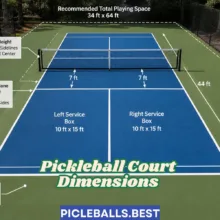
- Non-Volley Zone (Kitchen) Violations The non-volley zone, commonly called the “kitchen,” is the area within 7 feet of the net on both sides. Kitchen violations are among the most common faults in pickleball. These include:
- Volleying the ball while standing in the kitchen or touching the kitchen line
- Momentum carrying a player into the kitchen after a volley
- A player’s clothing or paddle touching the kitchen during a volley
To avoid kitchen faults, practice good footwork and spatial awareness. Always be conscious of your position relative to the kitchen line, especially when approaching the net for a volley.
- Boundary Faults Boundary faults occur when the ball lands outside the court’s designated lines. In pickleball, the lines are considered “in,” except for the non-volley zone line on serves. Players must be careful not to touch a ball that’s going out of bounds, as this results in a fault against them.
To avoid boundary faults, work on your shot accuracy and exercise restraint on close calls. It’s better to let a close ball go out than to hit it and risk a fault.
- Net Faults Net faults happen when a player, their clothing, or their paddle touches the net while the ball is in play. Additionally, hitting the ball into the net on a serve is a fault, and players are not allowed to reach over the net to hit the ball unless it has already crossed their side.
To avoid net faults, maintain a safe distance from the net during play and be aware of your paddle’s position, especially when hitting shots close to the net.
- Double Bounce Faults After the initial two-bounce rule is satisfied, allowing the ball to bounce twice on your side before hitting it results in a fault. Quick reflexes and good court coverage are essential to prevent double bounces.
To avoid double bounce faults, work on your agility and court positioning. Always be ready to move quickly to reach the ball after a single bounce.
Strategies to Avoid Faults
- Study the Rules: Thoroughly familiarize yourself with the official pickleball rulebook. Understanding the nuances of the rules will help you avoid unintentional faults.
- Practice Proper Techniques: Focus on developing correct serving, volleying, and dinking techniques. Proper form will naturally help you avoid many common faults.
- Improve Footwork: Good footwork is crucial in pickleball. Practice drills that enhance your agility and court coverage to avoid kitchen violations and double bounce faults.
- Develop Court Awareness: Always be conscious of your position on the court, especially in relation to the kitchen line and boundaries.
- Focus on Control: Instead of always going for power shots, focus on control and placement. This will help reduce out-of-bounds hits and improve your overall game.
- Communication in Doubles: In doubles play, clear communication with your partner can help avoid faults caused by confusion or lack of coordination.
- Watch and Learn: Observe experienced players and professional matches to see how they navigate the rules and avoid faults.
Potential Downsides and Challenges
While focusing on avoiding faults is crucial for improving your pickleball game, there are some potential downsides to consider:
- Overcautiousness: Becoming too focused on avoiding faults might lead to overly cautious play, potentially limiting your offensive capabilities.
- Mental Pressure: Constant worry about committing faults can create unnecessary mental stress, affecting your overall enjoyment of the game.
- Slowed Reaction Time: Overthinking each move to avoid faults might slow down your natural reactions and instincts on the court.
- Reduced Aggression: Fear of committing faults, especially around the kitchen area, might make players less likely to attempt aggressive plays that could be game-changing.
- Learning Curve: For new players, the numerous rules and potential faults can seem overwhelming at first, potentially discouraging some from fully engaging with the sport.
Conclusion
Understanding and avoiding faults is an essential part of becoming a skilled pickleball player. By focusing on proper technique, court awareness, and a thorough knowledge of the rules, you can significantly reduce the number of faults you commit during play. Remember, the goal is not just to avoid faults but to use this knowledge to enhance your overall strategy and enjoyment of the game.
As you continue to practice and play, you’ll find that avoiding faults becomes second nature, allowing you to focus more on the strategic and fun aspects of pickleball. Embrace the learning process, and don’t be discouraged by occasional faults – they’re part of the journey to becoming a better player. With time and practice, you’ll master the art of playing clean, fault-free pickleball, elevating your game to new heights.
#1 Pickball Balls | #1 Pickball Bag | #1 Pickball Portable Net |
 19500+ Reviews Free Shipping at Amazon.com |  2600+ Reviews Free Shipping at Amazon.com |  1800+ Reviews Free Shipping at Amazon.com |
Summary and FAQs
What is the most common fault in pickleball for beginners?
Kitchen violations (non-volley zone violations) are among the most common faults for beginners in pickleball. This occurs when players:
Volley the ball while:
- Standing in the kitchen (7-foot zone near the net)
- Touching the kitchen line
- Having momentum carry them into the kitchen after the volley
- Having their clothing or paddle touch the kitchen during a volley
This is particularly challenging for beginners because:
- It requires constant spatial awareness
- Players often get caught up in the excitement of a rally and forget about their positioning
- The momentum rule is especially tricky since players need to anticipate where their body will end up after hitting the ball
- Many players coming from tennis are used to being able to volley from anywhere on the court
The article specifically calls out kitchen violations as “among the most common faults in pickleball,” making them particularly problematic for those new to the sport who are still developing their court awareness and footwork skills.
How can I avoid committing kitchen (non-volley zone) faults?
Here are the key strategies to avoid kitchen (non-volley zone) faults:
Practice Good Footwork
- Stay conscious of your position relative to the kitchen line
- Maintain a safe buffer distance when volleying
- Practice proper backpedaling after shots near the kitchen
Develop Spatial Awareness
- Learn to recognize the kitchen line instinctively
- Pay attention to your momentum when approaching the net
- Keep track of not just your feet, but your paddle and clothing too
Use Proper Technique
- When volleying near the kitchen line, stay balanced
- Keep your weight back rather than leaning forward
- Take small, controlled steps rather than large lunges
Preventive Positioning
- Stand a comfortable distance behind the kitchen line
- If unsure about a shot near the kitchen, let it bounce
- Position yourself so your follow-through won’t carry you into the kitchen
Mental Strategies
- Before each point, note your position relative to the kitchen
- When in doubt, back up rather than move forward
- Stay focused on the kitchen line during fast-paced exchanges
Remember: It’s better to be slightly too far back than to risk a kitchen fault by being too close to the line.
Are There any exceptions to the double bounce fault rule?
Let me clarify the two distinct “double bounce” scenarios in pickleball:
The Two-Bounce Rule (Required Double Bounces)
- This rule REQUIRES the ball to bounce once on each side during:
- The serve
- The return of serve
- This is mandatory and has no exceptions
Regular Double Bounce Faults (Prohibited Double Bounces)
- After the initial two-bounce rule is satisfied
- The ball cannot bounce twice on your side before you hit it
- No exceptions are mentioned in the article
Important Distinction:
- Don’t confuse the “two-bounce rule” (which requires bounces) with a “double bounce fault” (which prohibits two bounces on one side)
- Once the initial two-bounce rule is completed, letting the ball bounce twice on your side is always a fault
To avoid double bounce faults, players should:
Be ready to move quickly to reach the ball after a single bounce
Work on agility
Improve court positioning
Maintain quick reflexes
Are there any exceptions to the double bounce fault rule?
There are no exceptions to the double bounce fault rule. Once the initial two-bounce rule (serve and return) is satisfied:
- A ball bouncing twice on your side is ALWAYS a fault
- No exceptions for weather conditions
- No exceptions for surface issues
- No exceptions for player position
- No exceptions for any other circumstances
This is one of the fundamental and absolute rules in pickleball that helps maintain fair play. The only way to avoid a double bounce fault is to hit the ball after a single bounce or before it bounces (volley) when permitted.
The article specifically focuses on preventing double bounce faults through:
- Quick reflexes
- Good court coverage
- Proper positioning
- Agility
So while there are many rules in pickleball that have nuances or exceptions, the double bounce fault rule is not one of them – it’s a strict rule with no exceptions.
Can I call a fault on my opponent?
This is an important aspect of pickleball etiquette that should be addressed.
In general pickleball play:
Line Calls
- Players make line calls only on their own side of the court
- You should only call lines on your side
- The receiving team makes the line call on serves
Fault Calls
- Players are responsible for calling their own faults
- You should not call faults on your opponents
- Exception: In officiated matches, the referee makes fault calls
Best Practices:
- Call faults on yourself when you commit them
- Trust your opponents to call their own faults
- If there’s uncertainty, replay the point
- If playing with a referee, defer to their calls
It’s important to note that calling faults on opponents goes against standard pickleball etiquette and fair play principles. The sport relies heavily on player integrity and self-officiating in recreational play.