
Pickleball Court Dimensions and Layout Explained | Best Pickleballs
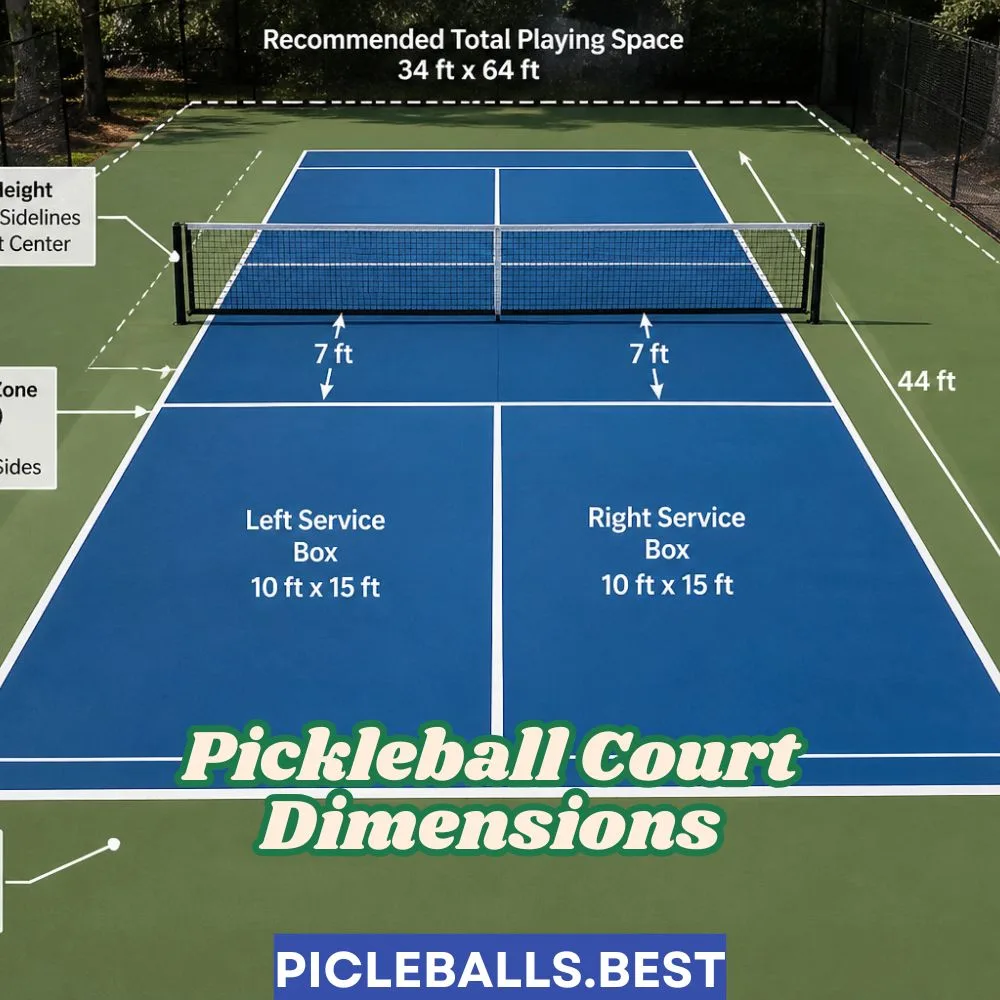
Pickleball court dimensions follow strict official standards that ensure fair and safe play. The court measures 20 feet wide by 44 feet long for both singles and doubles, with a recommended total space of 34 by 64 feet to allow safe movement. A key feature is the 7-foot non-volley zone, or kitchen, on each side of the net, which prevents aggressive net play and encourages strategic rallies. Service boxes measure 10 by 15 feet and are used for diagonal serving. The net height is 36 inches at the sidelines and 34 inches at the center. Proper court lines, spacing, and surface materials are essential for gameplay quality and safety. Understanding these dimensions helps players, builders, and facility planners create accurate and functional courts.
#1 Pickball Paddles Set of 2 | #1 Pickball Paddles Set of 4 | #1 Pickball Single Paddle |
 3000+ Reviews Free Shipping at Amazon.com |  200+ Reviews Free Shipping at Amazon.com |  800+ Reviews Free Shipping at Amazon.com |
Why Court Dimensions Matter in Pickleball
Pickleball has become one of the fastest-growing sports in the world, attracting millions of players across all age groups and skill levels. Central to the game’s appeal is its compact, accessible court — but that simplicity is deceptive. The precise dimensions of a pickleball court are governed by strict official standards, and understanding them is essential whether you are a beginner stepping onto the court for the first time, a facility manager planning a new installation, or a homeowner looking to build a backyard court. Getting the measurements right ensures fair play, player safety, and full compliance with USA Pickleball and International Federation of Pickleball (IFP) regulations. A court that is even slightly off can distort the game’s strategy, create unsafe conditions, and disqualify a venue from hosting sanctioned events.
Total Court Size: 20 × 44 Feet
The official playing surface of a pickleball court measures 20 feet wide by 44 feet long — a dimension that applies equally to both singles and doubles play. This gives the court a total playing area of 880 square feet, which is roughly one quarter the size of a standard tennis court. The relatively compact footprint is one of pickleball’s most celebrated features, making it possible to fit multiple courts into spaces originally designed for a single tennis court. The 44-foot length is divided symmetrically: each side of the net covers 22 feet of court from the net to the baseline. The 20-foot width accommodates two 10-foot-wide service boxes on each side of the net. These dimensions are non-negotiable at the competitive level and should be adhered to as closely as possible even in recreational settings.
Recommended Playing Space: 34 × 64 Feet for Safe Play
While the playing surface measures 20 × 44 feet, the recommended total area for a full pickleball court is 34 feet wide by 64 feet long. This additional space — 7 feet on each side and 10 feet behind each baseline — is not part of the official playing field but serves a critical safety function. It creates buffer zones that allow players to chase balls, decelerate after lunging shots, and move around the court without running into walls, fences, or other players on adjacent courts. For multi-court facilities, these buffer zones are especially important. Failing to provide adequate surrounding space is one of the most common mistakes made in recreational court construction, and it can significantly increase the risk of player injury.
The Non-Volley Zone (The Kitchen): The 7-Foot Rule
The non-volley zone — universally known as ‘the kitchen’ — is one of pickleball’s most distinctive and strategically important features. It is a rectangular area extending 7 feet from the net on both sides of the court, spanning the full 20-foot width. This means the kitchen occupies a total of 14 feet of the court’s 44-foot length. The defining rule is that players may not volley the ball — that is, strike it before it bounces — while any part of their body or equipment is touching the kitchen or its boundary lines. This rule forces players to engage in longer rallies and prevents aggressive net rushers from simply poaching at the net. Mastering kitchen play — knowing when to enter it, when to retreat, and how to use it against your opponent — is widely considered the central skill of advanced pickleball.
Service Courts: The 10 × 15 Foot Boxes
Each side of the net is divided into two service boxes — a right service box and a left service box — each measuring 10 feet wide by 15 feet long. The server must stand behind the baseline and strike the ball diagonally into the opponent’s opposite service box. For example, a server standing in the right service box must land the serve in the opponent’s left service box. The 15-foot depth of each service box is measured from the non-volley line to the baseline (not from the net itself), meaning the kitchen’s 7 feet are not part of the service box. Understanding this layout is essential for new players, as confusion about service box boundaries is one of the most frequent sources of rules disputes in recreational play.
Net Dimensions: 36 Inches at Sidelines, 34 Inches at Center
The pickleball net stretches across the full 20-foot width of the court and is supported by posts positioned just outside the sidelines. The net stands 36 inches high at the sidelines and sags slightly to 34 inches at the center — a deliberate design that creates subtle strategic variation across different parts of the court. Shots played through the center of the net have a 2-inch lower clearance requirement, which is why the middle of the court is often targeted during competitive play. The net’s lower center height makes it easier to drive the ball through the middle, which is a key tactical consideration, particularly in doubles. Net height should always be verified before play, as nets that are too high or too low can materially affect the game’s fairness and feel.
Court Lines: Baselines, Sidelines, Centerline, and Kitchen Line
A pickleball court features four distinct types of lines, each serving a specific purpose. The baselines run along the back of the court on both sides, parallel to the net, marking the far boundary of play. The sidelines run the full 44-foot length of the court, perpendicular to the net, forming the lateral boundaries. The centerline divides each side’s playing area from the non-volley line to the baseline, creating the left and right service boxes. Finally, the non-volley line — also called the kitchen line — runs parallel to the net at 7 feet, defining the front edge of the kitchen. All court lines are standardized at 2 inches wide, and the lines are considered part of the court area they bound (meaning a ball landing on a line is generally in play, with the exception of the kitchen line on a serve). Lines should be clearly painted or taped in a color that contrasts strongly with the court surface.
Indoor vs. Outdoor Courts: Same Dimensions, Different Considerations
Official pickleball court dimensions are identical for indoor and outdoor play, but the two environments present very different construction and gameplay considerations. Indoor courts benefit from controlled lighting, consistent temperature, and no wind interference, making them ideal for year-round competitive play. Outdoor courts, by contrast, must account for sun angle (the court should ideally be oriented north-south to minimize glare during morning and afternoon play), prevailing wind direction, and surface drainage. Outdoor surfaces typically require a slight slope — approximately 1% grade — to allow rainwater to run off without pooling. Surface materials also differ: indoor courts are often wood, rubber, or sport tile, while outdoor courts are most commonly asphalt or concrete with an acrylic coating applied over the top for grip and durability.
Surface Materials and Court Color: Function Meets Visibility
The surface of a pickleball court plays a major role in player comfort, ball bounce consistency, and injury prevention. Asphalt and concrete are the most common outdoor base materials, with an acrylic sport coating applied over the top. Modular interlocking sport tiles are a popular option for temporary or portable court setups. The color of the court matters more than most players realize: USA Pickleball guidelines recommend that the kitchen zone be painted in a clearly contrasting color from the rest of the court surface. This helps players make instant, confident line calls during fast-paced rallies without needing to interrupt play for disputes. A well-painted court with clearly contrasting zones and bold white lines not only looks professional but also meaningfully reduces on-court conflicts.
Pickleball Court vs. Tennis Court: Key Size Differences
One of the most practical comparisons for facility planners and recreational builders is the relationship between pickleball and tennis courts. A standard tennis court for doubles measures 36 feet wide by 78 feet long — significantly larger than a pickleball court in both dimensions. The size difference means that two to four pickleball courts can typically be fitted within the footprint of a single tennis court, which has fueled a widespread trend of tennis court conversions across the United States. The net heights also differ: a tennis net is 42 inches high at the posts and 36 inches at the center, compared to pickleball’s 36-inch posts and 34-inch center. When converting a tennis court, players often use temporary pickleball nets and court tape to create accurate playing surfaces without permanently altering the underlying tennis infrastructure.
Singles vs. Doubles: The Court Does Not Change
Unlike tennis, where the doubles alley expands the playable width of the court for doubles matches, pickleball uses the exact same 20 × 44 foot court for both singles and doubles. There are no additional zones that come into or out of play depending on the format. This simplicity is part of what makes pickleball so easy to learn, but it also means that singles players must cover the full width of the court alone — a considerable physical challenge that makes singles a significantly more demanding format than doubles for recreational players. Strategy in singles pickleball differs substantially from doubles, with more emphasis on baseline play and angled shots, precisely because there is no partner to cover half the court.
Multi-Court Spacing: Planning for Facilities
When designing a facility with multiple pickleball courts, proper spacing between courts is a critical safety and operational concern. USA Pickleball recommends a minimum of 10 feet between adjacent courts, though professional tournament facilities often use 12 to 15 feet. This buffer prevents players on neighboring courts from interfering with each other’s play, reduces collision risks, and allows room for spectators, ball retrieval, and referee positioning. Courts should also be planned with sufficient perimeter fencing to contain balls and define playing areas. When multiple courts are grouped together, sound management becomes a factor as well — the distinctive pop of pickleball play is notoriously loud, and high-density court clusters in residential areas have generated noise complaints in communities across the country.
How to Mark or Build Your Own Pickleball Court
Setting up a pickleball court requires basic tools: a 50-foot tape measure, chalk or permanent court tape, a straight edge or chalk line, and optionally a court-marking stencil kit. Begin by establishing the midpoint of the net, then measure outward 10 feet to each sideline. From each sideline post, measure 22 feet to mark each baseline. Next, measure 7 feet from the net on both sides to mark the kitchen lines, and divide each service area in half with a centerline. Before finalizing any lines, verify that the court is perfectly rectangular by measuring the diagonals — both corner-to-corner measurements must be equal. On a 20 × 44 ft court, the correct diagonal is approximately 48.1 feet. Finally, ensure all lines are painted or taped at the standard 2-inch width.
Common Setup Mistakes to Avoid
Even experienced builders make measurement errors when laying out a pickleball court for the first time. The most common mistake is measuring the 7-foot kitchen distance from the net post rather than from the center of the net, which can introduce a small but meaningful error. Another frequent error is using lines wider than the 2-inch standard, which artificially narrows the court’s playable space and can create confusion about ball placement. Failing to verify diagonal measurements often results in a slightly trapezoidal court that looks correct from the sides but distorts shot geometry. Perhaps the most consequential oversight is not accounting for the recommended 34 × 64 ft total area, resulting in courts that are technically correctly sized but dangerously close to walls or other courts.
Official Standards: USA Pickleball and IFP Guidelines
All dimensions described in this article align with the official standards published by USA Pickleball (formerly the USAPA) and the International Federation of Pickleball (IFP). These organizations maintain comprehensive rulebooks that govern not only court dimensions but also net specifications, surface requirements, and lighting standards for sanctioned play. Any court intended to host official tournaments must be inspected and approved against these standards. USA Pickleball regularly updates its guidelines, so facility managers and serious builders should consult the most current edition of the official rulebook directly at usapickleball.org before beginning construction. Recreational courts have more flexibility, but adhering to official standards wherever possible ensures that players develop accurate technique and court awareness that will transfer to any competitive setting.
Conclusion: Getting the Dimensions Right
Understanding pickleball court dimensions is not merely a technical exercise — it is the foundation of a safe, fair, and enjoyable game. A court that measures 20 × 44 feet with a 7-foot kitchen, 10 × 15 foot service boxes, properly placed lines, and a net at 36/34 inches creates the precise playing environment that pickleball’s rules and strategies were designed around. Whether you are building a backyard court on a tight budget, converting a tennis facility, or simply trying to better understand the game you love, getting these measurements right matters. The extra time spent verifying your lines, confirming your diagonal, and ensuring adequate surrounding buffer space will pay dividends in every game you play on that court for years to come.
#1 Pickball Balls | #1 Pickball Bag | #1 Pickball Portable Net |
 19500+ Reviews Free Shipping at Amazon.com |  2600+ Reviews Free Shipping at Amazon.com |  1800+ Reviews Free Shipping at Amazon.com |
Summary and FAQs
What are the official dimensions of a pickleball court?
The official pickleball court measures 20 feet wide and 44 feet long
How large should the total playing area be including safety space?
The recommended total playing space is 34 feet wide and 64 feet long
What is the purpose and size of the non-volley zone (kitchen)?
The kitchen is a 7-foot non-volley zone extending from the net on both sides
What are the dimensions of the service boxes in pickleball?
Each service box measures 10 feet in width and 15 feet in length
What is the standard height of a pickleball net?
The net height is 36 inches at the sidelines and 34 inches at the center


