Pickleball vs Tennis Court | Best Pickleballs
Pickleball and tennis, while both racquet sports have distinct differences in their court layouts and gameplay. Pickleball courts are significantly smaller, measuring 44×20 feet compared to tennis courts at 78×36 feet. This size difference allows for multiple pickleball courts within one tennis court, impacting space utilization and gameplay intensity. Pickleball features unique elements like the “Non-Volley Zone” and uses lighter equipment, making it more accessible to a broader range of players. While tennis offers varied playing surfaces and a more intense workout, pickleball is known for its social nature and easier learning curve.
Both sports have different economic considerations, with pickleball generally being more cost-effective in terms of court construction and equipment. As pickleball’s popularity surges, facilities are adapting to accommodate both sports, leading to innovations in court design and management. The coexistence of these sports offers diverse options for racquet sport enthusiasts, catering to different preferences and skill levels.
#1 Pickball Paddles Set of 2 | #1 Pickball Paddles Set of 4 | #1 Pickball Single Paddle |
 3000+ Reviews Free Shipping at Amazon.com |  200+ Reviews Free Shipping at Amazon.com |  800+ Reviews Free Shipping at Amazon.com |
Pickleball vs Tennis Court: Understanding the Differences and Implications
In recent years, the sports world has witnessed an unprecedented surge in the popularity of pickleball, a racquet sport that combines elements of tennis, badminton, and table tennis. As this newcomer gains traction, it’s increasingly being compared to its more established cousin, tennis. While both sports share some similarities, their differences extend far beyond the court dimensions. This article delves into the distinctions between pickleball and tennis courts, exploring their unique characteristics, advantages, and potential drawbacks.
Court Dimensions and Layout
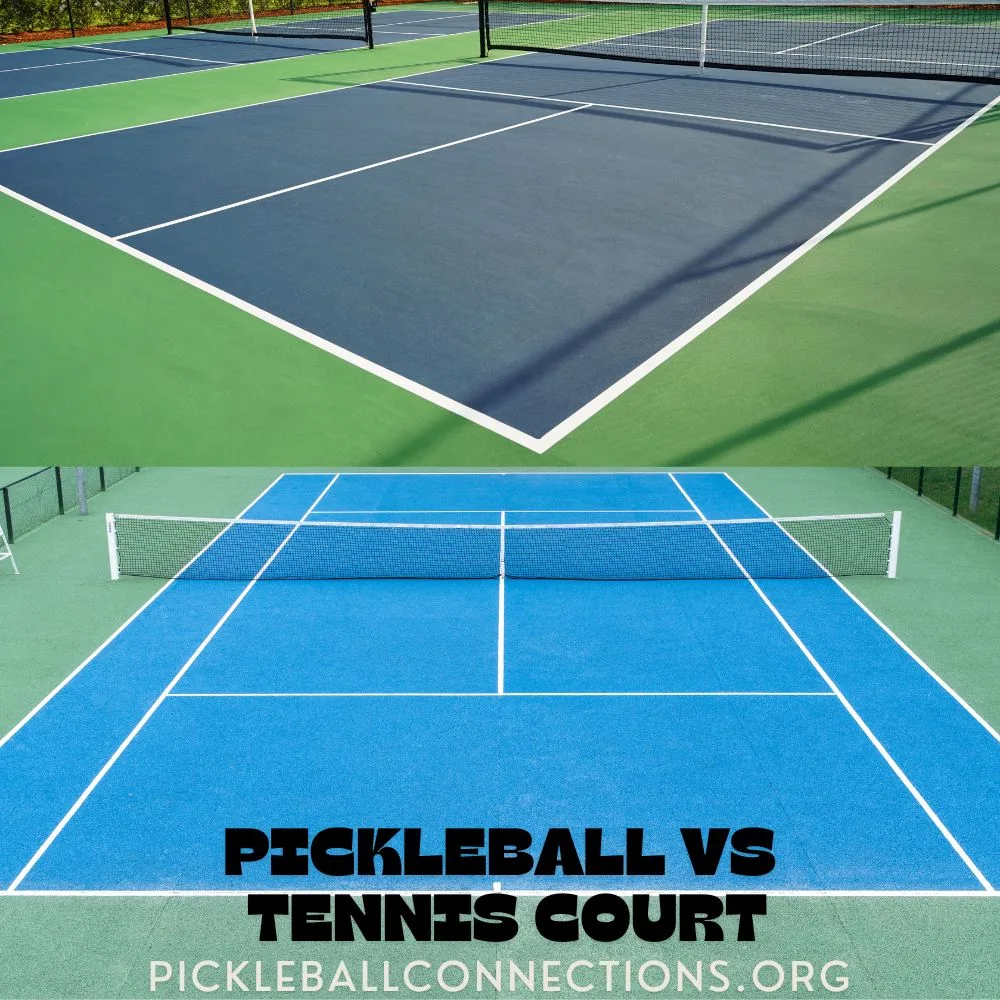
The most apparent difference between pickleball and tennis courts lies in their size. A standard tennis court measures 78 feet in length and 36 feet in width for doubles play (27 feet for singles). In contrast, a pickleball court is significantly smaller, spanning just 44 feet in length and 20 feet in width for both singles and doubles play.
This size disparity has several implications:
- Space Efficiency: Up to four pickleball courts can fit within the boundaries of a single tennis court, allowing for more players to participate in a given area.
- Accessibility: The smaller pickleball court is often more manageable for players with limited mobility or those new to racquet sports.
- Intensity: Tennis generally requires more running and covers a larger area, potentially offering a more intense cardiovascular workout.
- Conversion Potential: Existing tennis courts can be easily adapted for pickleball play, which has contributed to the sport’s rapid growth.
However, the smaller court size in pickleball can be a downside for some players who enjoy the more expansive play area that tennis offers.
Court Features and Markings
While both sports utilize a net and have similar basic court markings, there are notable differences:
- Net Height: Tennis nets are 36 inches high at the posts and 34 inches at the center. Pickleball nets are slightly lower, measuring 36 inches at the posts and 34 inches at the center.
- Non-Volley Zone: Pickleball courts feature a unique “Non-Volley Zone” or “Kitchen,” extending 7 feet from the net on each side. This zone is absent in tennis and significantly impacts gameplay strategy.
- Doubles Lines: Tennis courts have additional lines for doubles play, while pickleball courts maintain the same dimensions for both singles and doubles.
- Surface Types: Tennis is played on various surfaces, including clay, grass, hard court, and synthetic materials. Pickleball is primarily played on hard courts, limiting the variety of playing experiences but ensuring consistency across venues.
The specialized features of pickleball courts, particularly the Non-Volley Zone, add a unique strategic element to the game. However, this can also be seen as a limitation by some players who prefer the freedom of movement allowed in tennis.
Equipment Differences
The equipment used in tennis and pickleball differs significantly, influencing gameplay and strategy:
- Racquets vs. Paddles: Tennis uses larger, stringed racquets, while pickleball employs solid paddles similar to oversized ping-pong paddles.
- Balls: Tennis balls are felt-covered and pressurized, while pickleball uses lightweight plastic balls with holes.
- Weight and Control: Pickleball equipment is generally lighter, allowing for easier control and maneuverability, especially for beginners or older players.
- Cost: Pickleball equipment is typically more affordable than tennis gear, potentially making it more accessible to a broader range of players.
While the lighter equipment in pickleball can be advantageous for many players, it may not satisfy those who enjoy the power and precision offered by tennis racquets and balls.
Gameplay and Rules
Although both sports involve hitting a ball over a net, their rules and gameplay differ considerably:
- Serving: Pickleball has a unique underhand serving style, while tennis allows for more powerful overhand serves.
- Scoring: Pickleball uses a different scoring system, with games typically played to 11 points (win by 2), while tennis uses a more complex system of games and sets.
- Volleys: Pickleball restricts volleys near the net due to the Non-Volley Zone, adding a strategic element absent in tennis.
- Pace of Play: Pickleball generally has a faster pace of play, with shorter rallies and quicker points.
These differences in gameplay can make pickleball more accessible and enjoyable for some players, particularly beginners or those seeking a less physically demanding sport. However, tennis enthusiasts might find pickleball less challenging or lacking in the traditional aspects they enjoy.
Physical and Social Aspects
Tennis and pickleball offer different physical and social experiences:
- Physical Demands: Tennis generally provides a more intense cardiovascular workout due to the larger court size and faster-paced play. Pickleball, while still offering a good workout, is often less physically demanding.
- Accessibility: Pickleball’s smaller court and lighter equipment make it more accessible to a wider range of age groups and fitness levels.
- Social Dynamics: Pickleball is often characterized by more casual, social play and a strong community aspect. Tennis, while also social, can be more competitive and individualistic.
- Learning Curve: Many find pickleball easier to learn and play at a recreational level compared to tennis.
While pickleball’s accessibility and social nature are significant advantages, some players may prefer the more intense physical challenge and traditional competitive atmosphere of tennis.
Economic and Practical Considerations
The economics of court construction, maintenance, and equipment differ between tennis and pickleball:
- Construction Costs: Tennis courts are more expensive to build and maintain, especially grass and clay surfaces. Pickleball courts, being smaller, generally cost less to construct and maintain.
- Equipment Costs: Pickleball equipment is typically more affordable than tennis gear, potentially making it more accessible to a broader range of players.
- Facility Management: The smaller size of pickleball courts allows for more efficient use of space, potentially increasing revenue for facilities.
- Conversion Potential: Existing tennis courts can be easily adapted for pickleball, offering flexibility for facilities.
While the lower costs associated with pickleball are generally seen as an advantage, it’s worth noting that the sport’s rapid growth has led to increased demand for court time, potentially driving up costs in some areas.
Legal and Environmental Factors
The development and use of tennis and pickleball courts involve various legal and environmental considerations:
- Noise Regulations: Pickleball can generate more noise due to the distinctive sound of the ball hitting the paddle, potentially leading to conflicts in residential areas.
- Zoning Laws: The construction of new courts or the conversion of existing ones may be subject to local zoning regulations.
- Environmental Impact: Different court surfaces have varying environmental impacts, with natural surfaces like grass requiring more water and maintenance.
- Accessibility: Both sports need to consider accessibility for players with disabilities in court design and facility management.
The noise factor in pickleball has emerged as a significant concern in some communities, leading to restrictions on play times or court locations.
Conclusion
While tennis and pickleball share some similarities with net sports, they differ significantly in court size, equipment, rules, and player experience. Pickleball offers advantages in terms of accessibility, social engagement, and space efficiency, making it an attractive option for a wide range of players and facilities. However, it may not fully satisfy those who enjoy the physical intensity, traditional aspects, and varied playing surfaces of tennis.
As both sports continue to evolve, their coexistence offers exciting possibilities for diverse and inclusive racquet sports participation. The challenge for communities and sports facilities lies in balancing the growing demand for pickleball with the established presence of tennis, ensuring that both sports can thrive side by side.
Ultimately, the choice between pickleball and tennis courts depends on individual preferences, community needs, and available resources. As the landscape of racquet sports continues to change, embracing the unique attributes of both sports can lead to a richer, more diverse sporting environment that caters to a broad spectrum of players and enthusiasts.
#1 Pickball Balls | #1 Pickball Bag | #1 Pickball Portable Net |
 19500+ Reviews Free Shipping at Amazon.com |  2600+ Reviews Free Shipping at Amazon.com |  1800+ Reviews Free Shipping at Amazon.com |
Summary and FAQs
Can a tennis court be converted into a pickleball court?
Yes, a tennis court can be converted into pickleball courts quite efficiently. According to the information provided:
Space Efficiency: One tennis court can accommodate up to four pickleball courts due to the size difference:
- Tennis court: 78 feet long × 36 feet wide
- Pickleball court: 44 feet long × 20 feet wide
Easy Conversion Process:
- The article mentions that existing tennis courts can be “easily adapted for pickleball”
- This conversion potential has contributed to pickleball’s rapid growth
Cost-Effective:
- Converting existing tennis courts is generally more economical than building new dedicated pickleball courts
- Provides flexibility for facilities to accommodate both sports
Facility Management Benefits:
- Allows venues to maximize space usage
- Can potentially increase revenue by serving more players in the same space
- Offers versatility in programming and court scheduling
The only notable consideration mentioned is that some communities may need to address noise regulations, as pickleball can generate more noise due to the distinctive sound of the ball hitting the paddle.
What are the main differences in court size between pickleball and tennis?
Here are the key differences in court size between pickleball and tennis:
Tennis Court Dimensions:
- Length: 78 feet
- Width: 36 feet (doubles)
- Width: 27 feet (singles)
Pickleball Court Dimensions:
- Length: 44 feet
- Width: 20 feet (same for both singles and doubles)
Key Implications of Size Differences:
- Scale: A pickleball court is significantly smaller, being about 56% the length and 55% the width of a tennis court
- Practical Benefits:
- Up to 4 pickleball courts can fit within one tennis court
- More manageable for players with limited mobility
- More accessible for beginners
- More efficient use of space for facilities
Physical Impact:
- Tennis requires more running due to larger court size
- Tennis typically offers a more intense cardiovascular workout
- Pickleball’s smaller court makes it more accessible to various age groups and fitness levels
The only potential drawback mentioned is that some players might prefer the more expansive play area that tennis offers for a more challenging experience.
How does the “Kitchen” or Non-Volley Zone in pickleball affect gameplay compared to tennis?
I’ll explain how the “Kitchen” or Non-Volley Zone uniquely affects pickleball gameplay compared to tennis:
Key Differences:
Strategic Positioning
- Pickleball: Players must stay out of the 7-foot “Kitchen” zone when volleying, forcing them to be more strategic about their court position
- Tennis: Players can volley from anywhere on the court, including right at the net
Shot Selection
- Pickleball: The Kitchen rule prevents aggressive net-rushing tactics and power volleys from close range
- Tennis: Players can freely approach the net and hit volleys from any position
Rally Dynamics
- Pickleball: Creates a distinct “cat and mouse” game where players must carefully manage their distance from the Kitchen line
- Tennis: Allows for more traditional net play and aggressive serve-and-volley tactics
Player Movement
- Pickleball: Players must actively avoid stepping into the Kitchen when volleying, requiring careful footwork and awareness
- Tennis: Movement near the net is unrestricted, allowing more freedom in positioning
This fundamental difference in rules makes pickleball more about control and strategic positioning rather than the power and aggressive net play often seen in tennis. Would you like me to elaborate on any of these aspects?
Are pickleball courts more cost-effective than tennis courts?
Yes, pickleball courts are generally more cost-effective than tennis courts. Here’s a comprehensive breakdown:
Cost Advantages of Pickleball Courts:
Construction & Space Utilization
- Smaller footprint: Pickleball court is 44′ x 20′ vs tennis court’s 78′ x 36′
- Up to 4 pickleball courts can fit in one tennis court space
- Lower material costs due to smaller size
- Simpler surface requirements (primarily hard courts only)
Maintenance
- Less surface area to maintain
- Fewer maintenance requirements since they typically only use hard courts
- No specialized surface maintenance (unlike tennis’s clay or grass courts)
Facility Management Benefits
- Higher player capacity per square foot
- More efficient space utilization
- Potential for increased revenue per square foot
- Easy conversion from existing tennis courts
Equipment Considerations
- Lower equipment costs for facilities
- More affordable player equipment
- Less expensive replacement and upkeep
The only potential economic drawback mentioned in the article is that the growing popularity of pickleball has led to increased demand for court time, which might drive up usage costs in some areas. However, from a pure infrastructure and maintenance perspective, pickleball courts remain more cost-effective than tennis courts.
Which sport is more accessible for beginners or older players: pickleball or tennis?
Pickleball is generally more accessible for beginners and older players than tennis. Here’s a detailed breakdown:
Physical Accessibility:
Court Size
- Pickleball: Smaller 44′ x 20′ court requires less movement and stamina
- Tennis: Larger 78′ x 36′ court demands more running and endurance
Equipment
- Pickleball:
- Lighter paddles
- Easier to control equipment
- More manageable plastic balls
- Tennis:
- Heavier racquets
- More powerful equipment
- Faster, heavier balls
Learning Curve:
Gameplay
- Pickleball:
- Shorter rallies
- Underhand serves (easier to execute)
- Generally easier to learn at recreational level
- Tennis:
- Longer rallies
- Overhand serves (more technically demanding)
- Steeper learning curve
Social Aspects:
Community
- Pickleball:
- More casual, social atmosphere
- Strong community aspect
- Often more welcoming to newcomers
- Tennis:
- Can be more competitive
- More individualistic
- Traditional sporting atmosphere
Physical Demands:
- Pickleball: Lower intensity, good workout while being less physically demanding
- Tennis: More intense cardiovascular workout, requires greater physical effort
The article suggests that pickleball’s combination of lighter equipment, smaller court size, simpler rules, and more social atmosphere makes it particularly welcoming for beginners and older players while still providing good exercise benefits.